What is a Balinese cooking class?
A Balinese cooking class is typically a half-day program — usually 4 to 6 hours — that starts at a local morning market to select fresh ingredients and ends with you eating everything you have cooked for lunch. It is one of the most hands-on and culturally immersive things you can do in Bali.
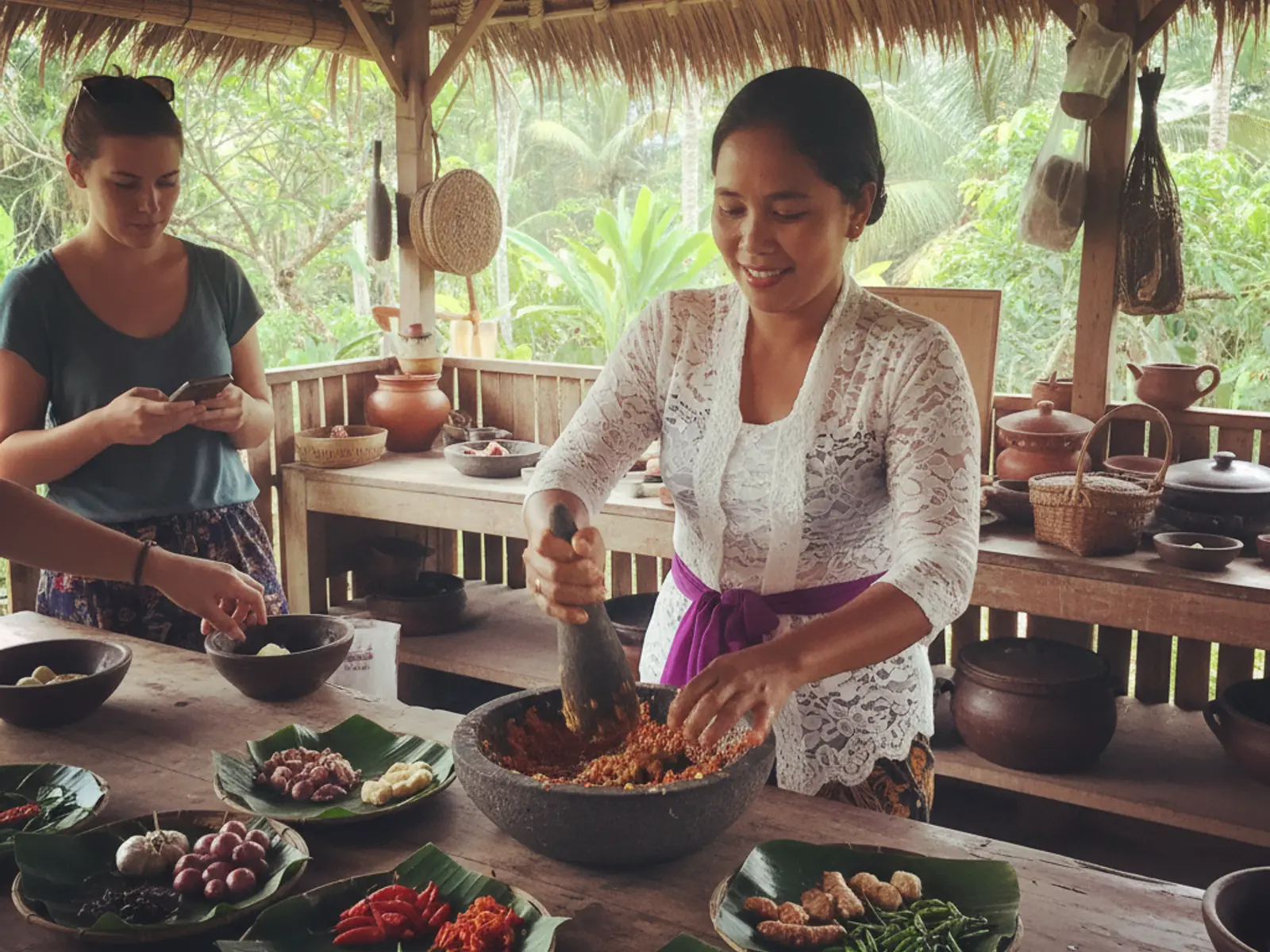
Balinese cuisine is built around bumbu — a complex spice paste made from shallots, garlic, galangal, turmeric, lemongrass, candlenut, chilli and shrimp paste, ground together by hand on a stone mortar. Learning to make bumbu from scratch is the foundation of almost every cooking class on the island, and it is the skill most students cite as the most valuable takeaway.
Most classes teach 4–8 dishes: typically nasi goreng, satay lilit (minced seafood satay), lawar (spiced minced meat with coconut), Balinese fried rice, chicken curry, black rice pudding and fresh tropical fruit juice. Some classes also include how to make jamu (traditional herbal tonic) and offerings from banana leaf.
Classes are held in a range of settings: home kitchens in villages (the most authentic), professional cooking studios in Ubud, open-air pavilions at boutique hotels or organic farm settings in Sidemen. Group sizes are usually 4–12 people for the shared experience format.
Best locations
Ubud — most concentrated, best variety
Ubud has more cooking schools per square kilometre than anywhere else in Bali. Most include a morning market visit at Ubud Traditional Market (Pasar Ubud) on Jalan Sriwijaya. The classes range from budget-friendly village homestays to the more polished Paon Cooking Class experience operated from a family compound in the rice fields.
Sidemen — most authentic setting
The Sidemen Valley in east Bali offers village-based cooking classes surrounded by rice paddies and views of Gunung Agung. These are typically run from a local family home and include Balinese Hindu ritual context — offering-making, temple shrine visits and the meaning behind specific ingredients. Lower tourist volume than Ubud.
Canggu and Seminyak — modern, social format
Several cooking schools in the Canggu-Seminyak strip cater to the café crowd with a more contemporary format — smaller groups, Instagram-friendly settings, sometimes including a glass of arak or sopi as you cook. Less traditional but enjoyable for younger travellers.
Pricing
| Format | IDR | USD equiv. | Includes |
|---|---|---|---|
| Group class (6–12 pax) | Rp 350,000 – 550,000 | $22 – $34 | Market visit, 4–6 dishes, lunch |
| Semi-private (2–4 pax) | Rp 500,000 – 750,000 | $31 – $47 | Market, 6–8 dishes, lunch |
| Private class (1 pax) | Rp 750,000 – 1,200,000 | $47 – $75 | Personalised menu, full day |
| Premium farm-to-table class | Rp 750,000 – 1,000,000 | $47 – $63 | Organic farm, 8 dishes, drink |
| Hotel cooking experience | Rp 850,000 – 1,500,000 | $53 – $94 | Chef-led, 4–6 dishes, lunch |
All reputable classes include lunch — you eat what you cook. Free hotel pickup is included by most Ubud operators within a 5km radius.
What is typically included
- ✓Morning market visit with your instructor to select fresh produce and spices
- ✓Introduction to Balinese spices, herbs and their medicinal properties
- ✓Hands-on cooking of 4–8 traditional dishes
- ✓Recipe booklet to take home
- ✓Full lunch of the dishes you prepared
- ✓Fresh fruit or juice welcome drink
- ✓Return hotel transfer (within area)
What to bring
- →Comfortable clothing you do not mind getting food-stained
- →Closed-toe shoes or sandals with a strap (kitchen floors can be slippery)
- →Appetite — classes typically run from 8am through to 1pm or 2pm
- →Camera for capturing the spice preparation process
- →Any dietary restrictions noted in advance (most instructors accommodate fully)
Best season
Cooking classes run year-round and are largely unaffected by weather — you are cooking indoors or under a covered pavilion. Demand peaks in July and August when advance booking is advisable. The wet season (November–March) is an excellent time for cooking classes as visitor numbers are lower, you often get more one-on-one time with the instructor, and prices are slightly lower.
Things to avoid
- Hotel-organised classes that are too polished: Some 5-star resort cooking classes are beautiful but teach a simplified, tourist-friendly version of Balinese cuisine — the food looks perfect but the cultural depth is minimal. Seek out family-run classes where the instructor grew up cooking these dishes.
- Large group classes (12+ people): In a large group, many students spend most of the time watching rather than cooking. Aim for classes with fewer than 10 participants per instructor.
- Booking without checking dietary accommodation: Many Balinese dishes contain shrimp paste, pork or fish. If you have dietary requirements, confirm in advance that the operator can genuinely substitute — not just describe the dish as vegetarian while using the same paste.
Frequently asked questions
Do I need cooking experience to take a Balinese cooking class?
No. Classes are designed for all levels including complete beginners. Instructors guide every step and do not assume any prior knowledge.
Is the morning market visit part of every class?
Most classes include a market visit, but some skip it for time or logistics reasons. The market visit adds 45–60 minutes to the program and is one of the highlights — choose a class that includes it.
Can vegetarians and vegans do a cooking class?
Yes. Almost all operators offer vegetarian menus. Vegan is possible but requires advance notice because Balinese cooking uses shrimp paste in many base sauces — the instructor will use an alternative.
Will I actually be cooking or mostly watching?
In properly run classes everyone cooks everything. Each participant has their own chopping board, mortar and pestle and wok station. Watch out for classes where students take turns — this produces a passive experience.
How far in advance should I book?
For group classes, 1–2 days ahead is usually fine outside July–August. In peak season, book 3–5 days ahead. Private classes can often be arranged same-day with 24 hours notice.
Is it safe to eat the food given food hygiene standards?
Yes. Cooking classes serve the food they teach — it is freshly prepared with market ingredients in a clean kitchen. Operators who run classes long-term have established hygiene standards. The greater food safety risk in Bali is eating at poorly maintained warungs, not cooking schools.
Ready to book or have questions?
WhatsApp us directly — free trip planning help, real reply in about 10 minutes.
Message +62 882-4569-741