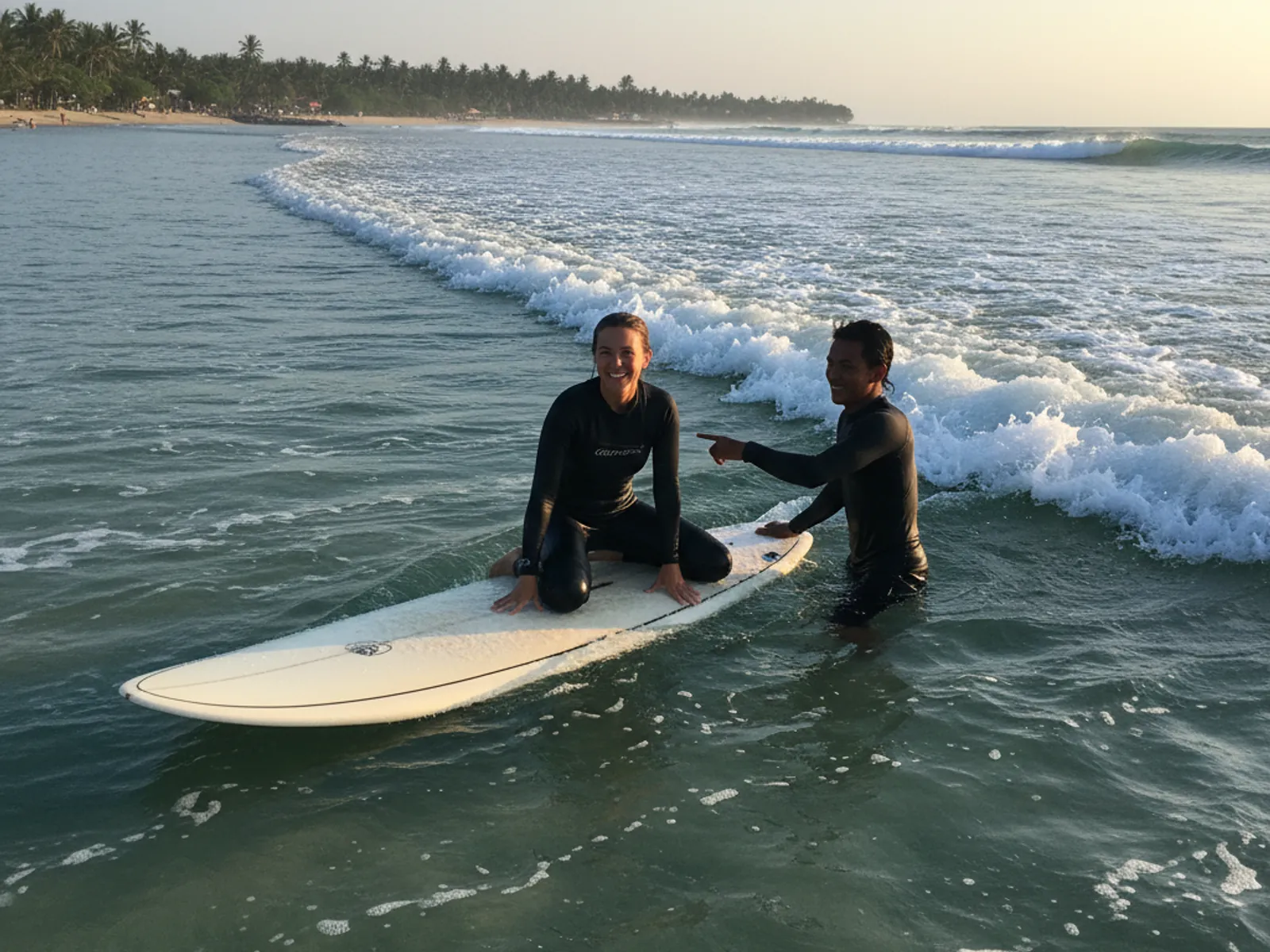
What is a surfing lesson in Bali?
A surfing lesson in Bali is a structured session — usually two hours — led by a certified local surf instructor who teaches you the basics of paddling, popping up, reading the wave and staying safe in the ocean. Lessons almost always take place on foam longboards (softboards) in white-water beach breaks where the water is shallow, the waves are forgiving and the sandy bottom is kind to falls.
Bali has been producing world-class surfers and surf instructors for decades. The local Balinese guides grew up surfing these exact breaks and know every nuance of the tide, the swell direction and how to position a beginner for the best chance of standing up on their first lesson.
Why is Bali particularly great for learning? First, warm water year-round — 26–29°C — means no wetsuit and no hesitation about getting in. Second, the wave density: within 30 minutes of any major area (Canggu, Kuta, Seminyak) you are at a beach with consistent, rideable surf nearly every single day. Third, the infrastructure: surfboard rentals, rinsing facilities, warungs right on the beach and a culture that is completely tuned to welcoming first-timers.
Progression is fast here. Many first-timers stand up within their first session. Most people taking 3–5 lessons across a week leave with enough skill to rent a board independently and paddle out on small days.
Best locations by skill level
Beginner — Batu Bolong (Canggu) and Kuta Beach
Batu Bolong is Canggu's most popular learner wave. It breaks on a mixed sand and rocky bottom, produces consistent white-water rolling waves and has multiple surf schools operating from the beach. Kuta Beach has the longest stretch of learner white-water on the island and is where the Bali surf school industry began. Both spots work almost every day of the year.
Intermediate — Bingin, Balangan, Medewi
Bingin is a punchy, shallow left-hander in Uluwatu that suits surfers who can already read and catch unbroken waves. Balangan is longer and more forgiving with a beautiful long left face on south swells. Medewi, two hours west of Canggu, offers the longest soft left on the island — perfect for working on your bottom turn and cross-stepping a longboard.
Advanced — Uluwatu, Padang Padang, Keramas
Uluwatu (The Peak, Racetracks, Outside Corner) is a powerful, hollow reef break on a very shallow ledge. It is extremely crowded and not a place to learn how to handle a reef. Padang Padang proper is a short, thick barrel — one of the best lefts in Asia when it is on. Keramas on the east coast is a fast, punchy right-hander that hosts professional competitions.
Pricing — what you actually pay
| Type | IDR | USD equiv. | Includes |
|---|---|---|---|
| Group lesson (2–6 people) | Rp 400,000 – 650,000 | $25 – $41 | 2h, board, rashguard, instructor |
| Private lesson (1-on-1) | Rp 750,000 – 1,200,000 | $47 – $75 | 2h, board, rashguard, dedicated coach |
| 3-day surf course | Rp 1,500,000 – 2,500,000 | $94 – $156 | 6h total, video analysis, theory |
| Board rental (no instructor) | Rp 70,000 – 150,000/hr | $4 – $9/hr | Softboard or hardboard only |
Prices above reflect 2026 market rates at beach shops. Resort or hotel surf packages are typically 40–60% more expensive for the same lesson.
What is included in a standard lesson
- ✓Softboard (foam longboard, 8–9ft) suited to your height and weight
- ✓Rashguard or lycra vest — UV protection and board rash prevention
- ✓Certified local instructor (usually ISA or POSSI accredited)
- ✓30-minute land session: paddling technique, pop-up drill, wave reading
- ✓90 minutes in the water with constant instructor feedback
- ✓Post-session debrief and tips on what to work on next
Most beach schools do not include transport or food, though many are adjacent to warungs. A few Canggu surf camps include breakfast and transport from your accommodation for slightly higher rates.
What to bring
- →Swimsuit or boardshorts (you will get completely wet)
- →Sunscreen — reef-safe SPF 50 minimum
- →Small waterproof bag for valuables
- →Change of clothes and towel
- →Flip-flops (most beaches have rocks near the shore)
- →Cash (IDR) — many beach stalls do not accept cards
- →Water bottle — 2 hours of paddling is dehydrating
Best season and best time of day
The west-coast breaks (Canggu, Kuta, Seminyak, Uluwatu) are best from April to October when south-southwest groundswells arrive regularly and the trade winds blow offshore in the morning — this is the optimal condition for clean, rideable waves. July and August are the peak of surf season but also the busiest crowds.
The east-coast breaks (Nusa Dua, Keramas, Sanur) work in the wet season (November–March) when the swell wraps around the east side of the island. This gives year-round surfing somewhere on the island.
Best time of day: early morning (6am–9am) gives the cleanest conditions — offshore winds, low crowds and the best light. By midday the onshore sea breeze often picks up and makes the waves choppy. Sunset sessions can be beautiful but the water gets crowded.
Safety considerations
Rip currents: Batu Bolong and Kuta both have rip currents on larger swells. If you are caught in one, paddle parallel to shore — not against it. Your instructor will brief you on the rip channels before entering.
Reef breaks: Uluwatu, Padang Padang, Bingin and Keramas all break over sharp, shallow coral reef. Reef boots are advisable. Never go alone, always let an experienced surfer show you the channel entry.
Currents and tides: Bali tides shift dramatically. A spot that is 2 feet at high tide can become 6 feet and heavy at low tide. Ask your instructor what the tide is doing before paddling out.
Sun: Bali sits 8 degrees south of the equator. UV is intense even on cloudy days. Reapply sunscreen every 90 minutes and wear a long-sleeved rashguard.
Travel insurance: Arrange cover that specifically includes surfing. Emergency helicopter evacuation from Uluwatu to BIMC Hospital in Kuta is real and expensive without insurance.
How to book a surf lesson
The simplest approach: walk up to any surf school on Batu Bolong or Kuta Beach in the morning and book for the same day — there is almost always availability except peak July–August weekends. Prices are fixed and visible on boards outside most schools.
For private lessons, video coaching or multi-day courses, it is worth contacting in advance. WhatsApp us at +62 882-4569-741 and we can recommend a trusted instructor matched to your current level, goals and budget — at no extra cost to you.
Common scams and things to avoid
- Unlicensed "instructors" on the beach: Some individuals offer lessons on the sand for Rp 150,000–200,000 with no accreditation, no rashguard and no safety briefing. If an instructor cannot show ISA or POSSI certification, walk to the next school.
- Board damage claims: Always inspect the board before and after your rental. Photo any existing dings. Dishonest shops occasionally claim damage happened during your session.
- Tourist-price surge at peak times: July–August prices can jump 30–50% above normal. Book schools that display fixed prices.
- Overcrowded learner breaks: Some schools put 8–10 beginners per instructor in the water at once. That is unsafe and counter-productive. Ask how many students per instructor before booking — 3:1 is a reasonable maximum.
Frequently asked questions
Do I need to know how to swim to take a surfing lesson?
Basic swimming ability is required — you should be comfortable in the water and able to swim 50 metres. Learner breaks are shallow (waist to chest deep) but you will fall off the board frequently and need to swim back to it.
Is there a minimum age for surfing lessons in Bali?
Most schools accept children from 7–8 years old. Some run dedicated kids' programs on smaller boards with lighter instructors. There is no upper age limit — we regularly see 60+ year-olds learning for the first time.
What size board will I use as a beginner?
Foam longboards (softboards) between 8ft and 9ft 6in, depending on your height and weight. The extra volume makes paddling and balancing much easier. You will progress to a shorter hardboard once you can consistently ride green waves.
Can I surf if I am not very fit?
Paddling uses your shoulders, back and core significantly. A standard 2-hour beginner lesson is fine for most fitness levels. If you have a back or shoulder injury, let your instructor know before entering the water.
Is the water clean at Batu Bolong and Kuta?
Batu Bolong is generally clean. Kuta Beach has had periodic water quality issues after heavy rain when runoff flows onto the beach — avoid surfing at Kuta for 24 hours after significant rainfall.
What is the difference between a surf lesson and a surf guide session?
A lesson focuses on teaching technique to beginners in white-water. A surf guide session is for intermediate+ surfers who want local knowledge about which break to paddle out at based on the current conditions, and someone in the lineup to point out wave sets.
Ready to book or have questions?
WhatsApp us directly — free trip planning help, real reply in about 10 minutes.
Message +62 882-4569-741